
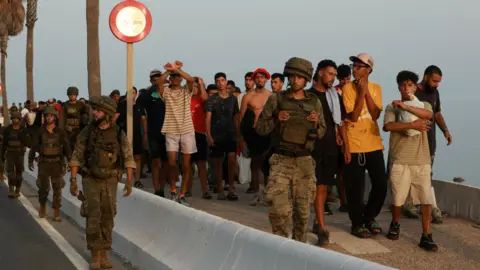
Most of the tens of thousands of migrants who swam into the Spanish exclave of Ceuta on Thursday have now returned to Morocco, escorted to the border by Spanish soldiers and police.
But the extraordinary surge of arrivals has left at least 72 people dead, their bodies pulled from the sea where they floated alongside abandoned rubber rings and flippers.
This week's events have also shaken Europe politically, once again exposing divisions over the sensitive issue of migration.
And they've left lingering questions about what sparked the sudden influx: whether social media posts promising an easy path to Europe just went viral or this was something more deliberate, even organised.
The politics
Whatever the cause, Spain's socialist prime minister is angry with the response.
Pedro Sanchez has hit out at some in the EU for "attacking" Spain in this crisis, playing politics instead of showing support.
He meant Italy, above all.
Fratelli d'Italia, the hard-right party of Prime Minister Giorgia Meloni, had been quick to post images of migrants racing through the streets of Ceuta.
"This is the Sanchez model the Italian left wing likes so much," the caption crowed.
Meloni then announced she was suspending Italy's Schengen agreement with Spain that allows for the free movement of people, citing a security threat.
Madrid is fuming.
The way Spain sees it, the crisis has been contained and Ceuta is not in the Schengen zone so Moroccan migrants were never going to head for mainland Europe, unchecked.
Meloni knows that.
But she faces elections next year with her coalition losing ground to a new and virulently anti-immigrant party. This was a chance to sound tough herself and claw back votes and she leaped on it.
Post a Comment